



Romana Zeman
When I was asked to write something about myself and my departure from Czechoslovakia, I was very surprised, because I had never tried to recapitulate my life. For some reason, I never felt the need to do so. I realized that it was extremely difficult. People usually try to forget the bad things and remember only the positive ones. Moreover, I had not written anything for many years. At school, I had the best essays, which motivated me to earn extra money as a student by writing columns for the newspaper Práce.
I was born into a family of a mechanical locksmith and a student of music conservatory. My father, thanks to his German father, who was deported from Czechoslovakia after the war, was not allowed to study. He obtained his high school diploma after distant learning in 1951. He also completed his studies in philosophy at the Faculty of Philosophy at the Charles University, remotely again. During his studies, he worked as a constructor and designer, and from 1963, he was Assistant professor at the Department of History of Philosophy and Logic, where he was teaching until 1969. A few years before my father was banned from any academic activity, he was also invited abroad to give lectures, for example at the universities in West Berlin, Bonn and Darmstadt.
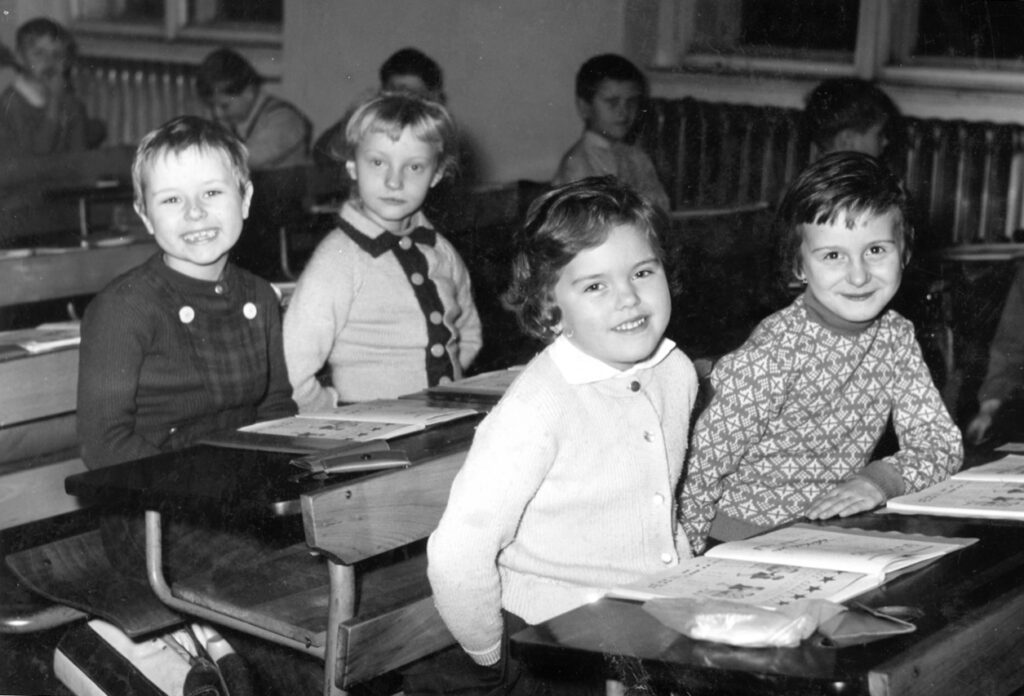
I always had a problem at school because I refused to say ``comrade teacher``
Since 1968, when my father was affiliated with the Faculty of Philosophy in Prague, I have been surrounded by intellectuals. Students from the faculty came to our place for discussions and to prepare for exams. As part of this group of inspiring people, I also experienced the entry of the Warsaw Pact troops, during the night of August 20-21, 1968. These tragic events began to shape my political and social views. I always had a problem at school because I refused to say “comrade teacher”. I always used “Mrs. teacher” instead, so I was not very popular among the pedagogues. I don’t even know how I managed to get the High school of Applied Arts (scenography), without help. In the fourth year, my class teacher invited me into her office and announced that she wouldn’t sign my recommendation for university because my father was not a member of the Communist Party, and he was also one of the founders of KAN (Club of Committed Non-Party Members). Unfortunately, that was during the Normalization period, when it was not possible for non-party members to study at the universities.
After signing a declaration that he would not lecture abroad, my father was finally able to travel to Germany after ten years, to say goodbye to his old father. He gave a few lectures there and a colleague reported him. Moreover, as a student of Professor Jan Patočka, he spoke at his funeral. He subsequently underwent six interrogations by the State Security and then died.
From that moment on, I waited for the best opportunity to leave Czechoslovakia. It was only after the birth of our second daughter when my husband Honza and I waited all night in front of the Balnea travel agency to get vouchers to travel. The whole family received a medical certificate that we needed the sea air, especially our daughters, who were really sick. After a year of waiting, we finally got a visa and left for Italy. What a surprise when we learned that the refugee camps were already full and closed because of African migrants. We were very lucky to meet a Czech priest from the Vatican, who helped us get to northern Italy, to the city of Trento, where not only the church but also the local residents helped us a lot.
We learned how to trust people again. We experienced the Velvet Revolution in Trento, but we refused to return to Czechoslovakia. We wanted to prove something abroad. However, we got to Canada in 1990, when the recession just began. For a family that didn’t speak English very well (especially me), it was actually impertinent to expect any help, so it was very difficult to make our way through. At the time we arrived to Canada, people were still very tolerant of foreigners, but they weren’t expected to help immigrants.
When we arrived in Vancouver, we heard that the family of Professor Vladimir Krajina, a former politician and hero of the anti-Nazi resistance who later became a successful botanist in British Columbia, was looking for someone to take care of him. He was well over eighty at the time. We met his daughter and accepted the job offer. We lived in the professor’s house for the last year of his life. I was also asked to transcribe his memoirs onto the computer. It was quite a challenging task, as I had to read 800 pages of manuscript in order to correct around 200 pages of the unfinished book.
Meanwhile, my husband Honza wanted to use his woodworking education from the University of Zvolen. He was advised to get a master’s degree in forestry, which is very different from woodworking. So, I had to financially support the entire family and earn money. Unfortunately, the school was left unfinished, and my husband had to start working, like many other immigrants, in the construction industry. In 1999, he got a job at a sawmill as an engineer. He worked in his engineering profession for only two years. Since then, he has been in the house construction business.
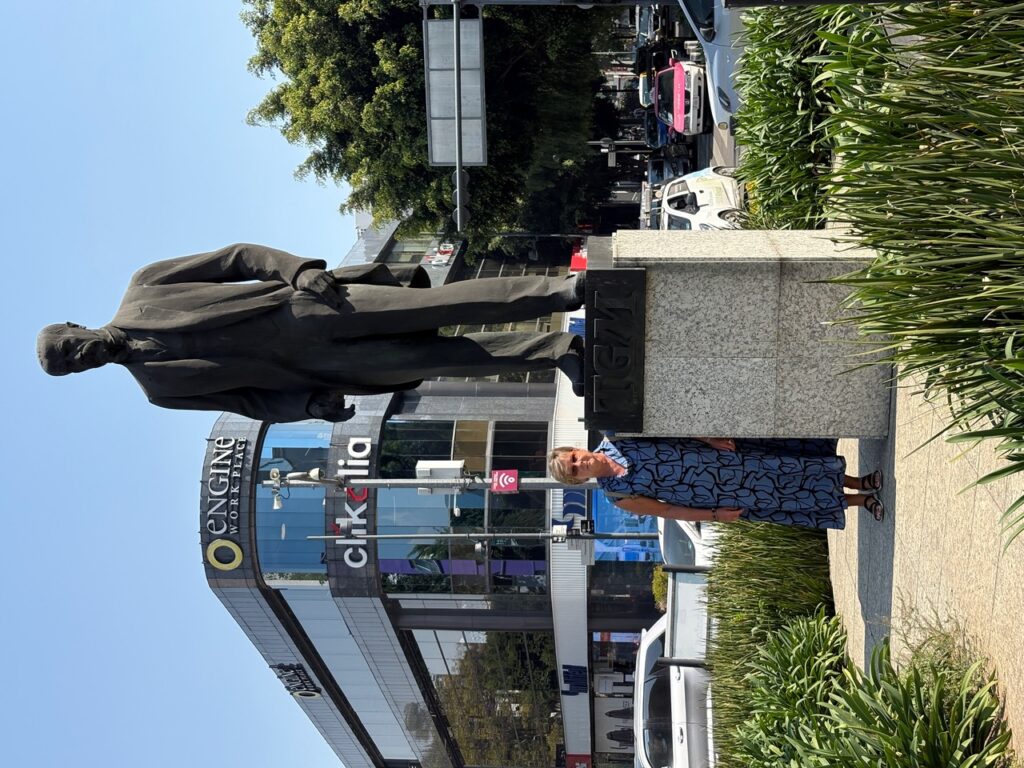
Thanks to this, I received the Tomáš Garrigue Masaryk Award in 2023
I have always been drawn to culture. So, I was always employed so that my family could have paid health benefits, but at night I did part-time graphic design. I got involved in Czech community and in 2007 I became the President of the Czech “Theatre around the corner”, replacing co-founder dr. Josef Skála, who retired. When I left the theater, I missed this artistic environment so much that my husband and I established “Art without Borders” company. We invited Czech and Slovak artists to Vancouver, mainly jazz musicians. I also got involved in the Czech and Slovak Association of Canada, and since 2013 I have been publishing a more than thirty-page magazine, Zpravodaj, presenting our activities in Vancouver. Thanks to this, I received the Tomáš Garrigue Masaryk Award in 2023. This is the highest award given by the Association. It is awarded to Canadians of Czech or Slovak origin for significant achievements, or to individuals and organizations that have contributed to a free Czechoslovakia or enriched the lives of Czechs and Slovaks in Canada.
Susanna HRNCIR
Ahoj Romanik!
Zdavim te z Rakozska.
US jsme se dlouho neslyseli!
……moc pozdavu pisila Zuzana HRNCIR 👋🏻😘😘😘Email: Susanna.hrncir@gmail.com
Kolik mas vnoucku?? Ja 3💕